
Sidework
A novella by Sasha Horn about the day in the life of a waitress who is living with her children and husband in a van.

I learned about Sidework in a post by Robin Marie MacCarthur while I was finishing up There Is No Place for Us Here, and I ordered it right away. After getting so stirred up on the topic of homelessness among the employed, how could I resist well-reviewed fiction about a waitress living with her family in a van? When it came, I read the first pages and immediately gave in to them, putting aside the novel I was in the middle of, which I seldom do.
The book opens with of a list of morning side work required by the servers at a restaurant. Fill all creamers, fill sani-buckets, put ketchups on table, fill salt, things like that. It triggered my muscle memory. I waitressed on and off for about 8 years in my teens and twenties, and apparently refilling saltshakers is like riding a bike, you never forget it, or the texture of the dried-on catsup around the bottle tops that needs to be soaked off before marrying the bottles so full ones are ready for the next day. Back then, the mandated wage for tipped service workers was about $2 an hour, and I am still indignant that rate applied to the time we spent doing side work, which could be grubby, physically demanding, and take an hour or more to complete, especially for breakfast shifts where there are lots of sticky little pieces that need fussed with. This book takes place during a single morning shift, starting when the narrator is opening up the restaurant.
At this hour, people think it’s so dark out here. But it’s 6 o’clock, folks. There’s light everywhere! Morning breath sparkles in the astronomical dawn, coating the wooden sidewalk with electric leaves. Dog owners walk their companions, back and forth, beneath mist passing through the wake of sodium lamps. They shine flashlights to illuminate the small thin line that they pace, cajoling, Go potty now. Come on. Go pee pee while I flip chairs off of porch table in the shadows, waiting for the sun.
As the restaurant gurgles away, I stand behind the swinging door, staring out the small round window into the street, praying, “Please, God, let this be a busy day. Please?”
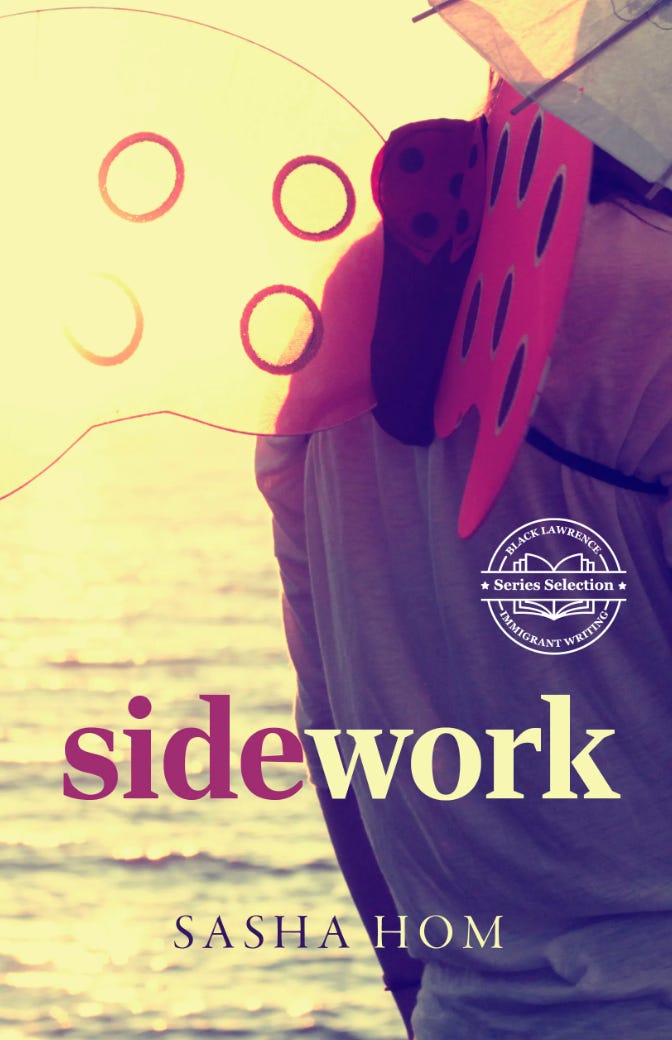
Hom captures the narrative and drama of a serving shift. The slow start. The other workers trickling in. The combination of teamwork, competition, and worker-management / front-of-house-back-of-house tension that affects the dynamics. The suspense of approaching a new customer, not knowing if they’ll bring trouble or cheer, how they’ll affect your week’s finances. My daughter works at a restaurant now, and most tips are put on credit cards and pooled. They wind up in her check rather than as a wad in her apron as mine used to. The restaurant in the book, in a historic building in an old Northern California railroad town, is cash only, which means the narrator’s apron gets heavier throughout her shift and needs to be retied, again as mine used to. But the narrator is supporting a family. The size of her tips matters more.
Her musings on the costs of things and her family’s context are threaded through the short chapters, themed vignettes told in chronological order. She relates the price of celery at the area’s various supermarkets and how it maps onto nearby overnight camping spots, and why her family sometimes ends up in the Walmart parking lot, where she nursed her baby that morning before heading to work. She envisions her kids going to pee in store after they wake up, the older helping the younger. She drops the amount they can afford to pay for housing, this family of four kids. There’s a zero percent vacancy rate in the county, and that was before the fires, and in addition to the kids the family includes two big dogs, who weigh more than allowed even in apartment complexes that otherwise permit pets.
Another thing worked in: The narrator’s hippy ways. Her family is vegan, social-justice oriented, they know flora and fauna, and how to repair and forage. Her husband, a musician, takes care of the kids, including their infant, while she works. They were living in an intentional community on a big piece of land before the fires displaced them. The extent to which they chose or were forced to live in a yurt rather than in a place with four walls and a roof is left fuzzy.
I’m interested in this fuzziness, this nominal choosing, and the inventiveness people display when typical housing is out of reach without major lifestyle changes. It’s been a fascination for me as long as I can remember, since reading the original Boxcar Children book when I was a child, and My Side of the Mountain by Jean Craighead George, where a boy leaves his family in the city to live alone in the woods. When I was twenty, during my waitressing days, I first met squatters in Philadelphia. I saw them as sort of urban environmentalists, survivalists of a back-to-the-land sort but living on the trolley line. If they had been willing to put all their time and energy into earning enough money to pay a rent, most of them probably could have. Rents were cheaper then. But they wanted to direct their labor and creativity in other ways, and were willing to make tradeoffs. In Sidework, the narrator flashes back to cooking for her intentional community with dumpster-dived ingredients, and it reminded me of those Philadelphia folks and others I met through them, that ethos. Why grind for capitalism when you can live on its waste, build community, and free your time and mind?
These days, when housing is so prohibitively expensive in so many areas, the question shifts a bit. Why grind for capitalism when you still won’t be able to afford a halfway decent life? How far should you contort yourself to play a rigged game you’re likely to lose? Nowadays I’m also aware of mental health and other disabilities that, especially in unforgiving circumstances, make “living like a normal person” a hard proposition.
But society tends to code Korean-Chinese-American dreadlocked intentional community members like the waitress in Sidework differently than Black mothers in line at Gateway Center in Atlanta. I think? Or it used to? Vegan has become a dirty word in some circles, and seems to be coded both as elite and pathetic, undeserving. This book also brings to mind one I read years ago, Nomadland by Jessica Bruder, source of the Chloé Zhao movie, where the RV-life subjects are mostly white.
Becoming so engrossed in Sidework and There Is No Place for Us Here has reminded me that the communities in my forthcoming novel Coin of the Realm are homeless-adjacent. In the early days of researching, I looked for inspiration in the Travelers communities in England, the Earth Ship movement in New Mexico, the squatters in the Lower East Side of NYC, and I tracked down related books about them all.

What happens if more of us look at the commonalities between groups who don’t have typical housing, with electricity, running water, and protection from the elements? What do we notice? What do we occlude?
Like most of the books that linger for me, Sidework’s appeal came from its use of language, scene, and imagery to convey a unique subjectivity and also from the connections it helped me make between what I see in the world and read about elsewhere. And I would have never found it without a casual click on a Substack post.